Everything You Need to Know About Sleep
Over 30 questions and answers about sleep, cycles, insomnia, melatonin and better rest.
Find answers to questions like how many hours you should sleep, how sleep cycles work, or what the ideal bedtime is — all in this comprehensive guide. You can also use our sleep calculator to find your ideal sleep schedule based on 90-minute cycles.
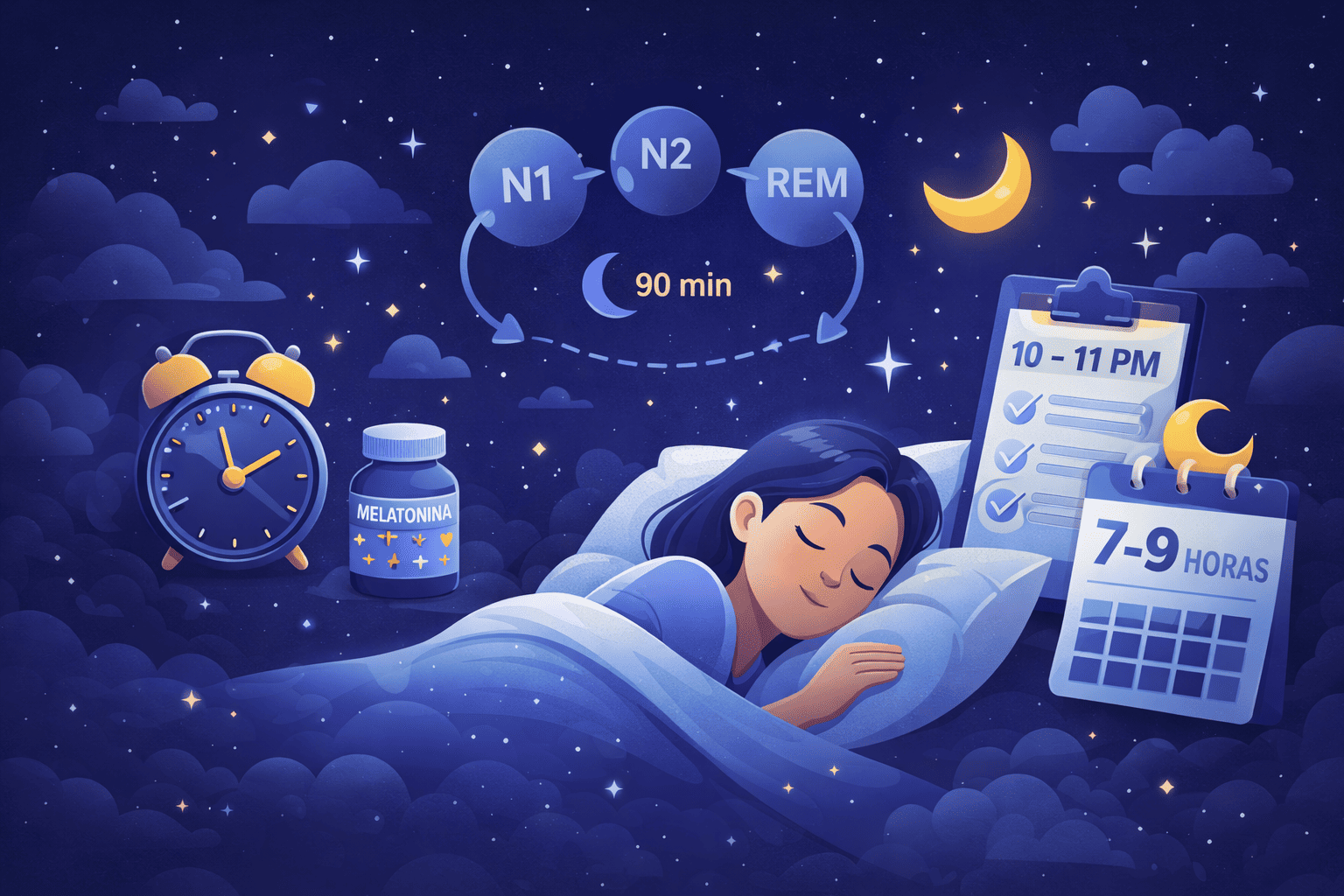
Frequently asked questions about sleep and rest cycles
It depends on your age. Adults (18–64) should sleep 7 to 9 hours per night. Teenagers need 8–10 hours, children 9–12 hours, and babies 12–17 hours. For those aged 65 and over, 7–8 hours is recommended. Quality matters just as much as quantity: 7 uninterrupted hours can be more restorative than 9 fragmented ones. Use our sleep calculator to find your optimal times.
Habitually sleeping fewer than 6 hours has serious consequences. In the short term, you'll experience poor concentration, irritability, slower reaction times, and increased appetite (especially for high-calorie foods). In the long term, the risks of obesity, type 2 diabetes, cardiovascular disease, and depression all increase. A weakened immune system also leaves you more vulnerable to infections.
Yes. Regularly sleeping more than 9–10 hours (without a medical reason) in adults is associated with daytime fatigue, headaches, depression, and increased cardiovascular risk. If you sleep more than 10 hours and still wake up tired, there may be an underlying issue such as sleep apnea or hypothyroidism. We recommend consulting a doctor.
Only partially. Sleeping in at the weekend can offset some of your sleep debt, but it does not reverse the cumulative effects of chronic sleep deprivation. Drastically shifting your sleep times at weekends ("social jet lag") also disrupts your biological clock and can reduce sleep quality during the following week. Use our sleep calculator to build a consistent cycle-based schedule.
Yes. Briefly waking up 1–2 times between sleep cycles during the night is completely normal. These awakenings are usually so short that you won't remember them. It becomes a problem if it takes more than 20 minutes to fall back asleep, if you wake up more than 3 times a night, or if you feel tired the next day.
This is called "sleep inertia." When you sleep too long, your alarm is likely to go off mid-cycle rather than at the end of a cycle. Excessive sleep also disrupts your circadian rhythm, leaving the body confused about whether it should be awake or asleep. This is why aligning with 90-minute cycles matters more than total hours. Calculate your exact wake-up time with our sleep cycle calculator.
A sleep cycle is one complete pass through all stages of sleep: light sleep → deep sleep → REM stage. It lasts approximately 90 minutes, though it can range from 80 to 120 minutes depending on the person. You complete 4 to 6 cycles per night. Deep sleep is more prevalent in the early cycles, while REM dominates the later ones.
For most adults, the ideal is 5 cycles (7.5 hours) or 6 cycles (9 hours). The functional minimum is 4 cycles (6 hours), though this is not recommended as a habit. Teenagers and children need more cycles. The most important thing is to wake up at the end of a cycle, not in the middle. Use our sleep calculator to pinpoint your bedtime.
REM (Rapid Eye Movement) is the stage where the vast majority of dreams occur. It is critical for memory consolidation, emotional processing, and creativity. During REM, the brain is as active as when you're awake, but the body remains temporarily paralysed. It accounts for 20–25% of total sleep time. REM deprivation can lead to memory problems, irritability, and difficulty learning.
Count backwards from your wake-up time in 90-minute blocks and add 15 minutes to fall asleep. For example, if you need to be up at 7:00 AM, ideal bedtimes are: 9:30 PM (6 cycles), 11:00 PM (5 cycles), or 12:30 AM (4 cycles). For a personalised calculation in seconds, use our sleep calculator.
This is a sign that your biological clock is well-calibrated. Your body anticipates the wake-up time by gradually raising cortisol levels and body temperature. It is a positive sign: you are naturally completing your sleep cycle. People with consistent sleep schedules experience this more often.
Newborns (0–3 months) need 14–17 hours, babies aged 4–11 months need 12–15 hours, and toddlers aged 1–3 need 11–14 hours including naps. Sleep is vital for brain development and the release of growth hormones. A regular sleep schedule is critically important at these ages.
It's biology, not laziness. During puberty, the biological clock shifts by approximately 2 hours, meaning teenagers naturally go to bed later and wake up later. They also need 8–10 hours for brain development. Early school start times work against this biology and can lead to chronic sleep debt.
Research suggests women may need on average 10–20 minutes more sleep than men. This is linked to differences in brain activity and multitasking capacity. Additionally, hormonal changes related to the menstrual cycle, pregnancy, and menopause can significantly affect sleep quality.
With age, melatonin production decreases, the deep sleep stage shortens, and nighttime awakenings become more frequent. The biological clock also shifts forward, which is why older adults tend to go to bed and wake up earlier. Maintaining a consistent routine, getting morning sunlight, and limiting naps can significantly improve this situation.
Pregnancy profoundly affects sleep. In the first trimester, rising progesterone levels cause excessive sleepiness. In the second trimester, sleep generally improves. In the third trimester, physical discomfort, frequent urination, and the baby's movements can make sleep more difficult. Sleeping on the left side improves blood circulation, and using a support pillow is recommended.
Insomnia is a persistent difficulty falling asleep or staying asleep. It can be acute (days to weeks, often stress-related) or chronic (3+ months). The most effective long-term treatment is Cognitive Behavioural Therapy for Insomnia (CBT-I), which includes sleep restriction, sleep hygiene, and relaxation techniques. Sleep medications are recommended only for short-term use.
Obstructive sleep apnea causes repeated pauses in breathing during the night, usually accompanied by loud snoring. The person stops breathing for 10–30 seconds, briefly wakes up (without remembering it), and falls back asleep. This can happen hundreds of times a night. Main symptoms: loud snoring, excessive daytime sleepiness, morning headaches, and difficulty concentrating. It is more common in men and overweight individuals and requires medical evaluation.
This is usually caused by an overactivated nervous system. The most common triggers are anxiety or mental rumination, screen exposure (blue light suppresses melatonin production), caffeine consumed in the afternoon, intense exercise close to bedtime, or an unsuitable sleep environment. The most effective approach: if you can't fall asleep within 20 minutes, get out of bed, do something relaxing, and return when you feel sleepy.
Sleep paralysis occurs when you are conscious but unable to move your body while waking up or falling asleep. It happens when the paralysis mechanism of REM sleep kicks in while you are awake. It can be accompanied by hallucinations and a feeling of pressure on the chest. Although frightening, it is harmless and lasts only seconds to minutes. It is more common with sleep deprivation, stress, and irregular sleep schedules.
Restless leg syndrome is a disorder that causes an irresistible urge to move the legs, usually accompanied by uncomfortable sensations such as tingling, burning, or itching. Symptoms worsen at rest and at night, making it hard to fall asleep. It may be linked to iron deficiency or genetic factors. If symptoms are frequent, consulting a doctor is recommended.
Seek professional help if: you have had sleep problems for more than 3 weeks, you snore loudly or a partner notices breathing pauses, you experience excessive daytime sleepiness that affects your work or driving, you display abnormal behaviours during sleep (sleepwalking, talking, etc.), or your legs are preventing you from resting at night.
It depends on how you nap. A 20–30 minute nap taken before 3:00 PM can improve alertness, performance, and mood. However, a long nap (over 45 minutes) or one taken late in the day can disrupt nighttime sleep and cause sleep inertia. If you suffer from insomnia, avoiding naps altogether to build "sleep pressure" may be more beneficial.
Melatonin is more effective at regulating sleep timing (jet lag, night shifts) than at treating insomnia. It is not a sleeping pill: it tells the body that it is time to sleep, but it does not make you sleep. Low doses (0.5–3 mg) taken 1–2 hours before bed are generally more effective than high doses. Consulting a doctor before regular use is recommended.
Blue light emitted by phones, tablets, and computers can suppress melatonin production by up to 50%, delaying the onset of sleep. Stimulating content such as social media, news, and games also activates the nervous system. It is recommended to switch off screens at least 60 minutes before bed, use night mode, and keep your phone outside the bedroom.
The ideal bedroom temperature is between 18°C and 20°C (64–68°F). For sleep, the body needs to lower its core temperature; a cool environment facilitates this process. Sleeping in a warm room above 24°C (75°F) reduces deep sleep and REM sleep. A warm bath taken 1–2 hours before bed actually helps by dilating blood vessels, speeding up heat loss, and paradoxically aiding sleep onset.
Yes, significantly. Caffeine has a half-life of 5–7 hours, meaning a coffee at 4:00 PM still retains half its effect at 10:00 PM. Even if you do fall asleep, caffeine reduces the amount of deep sleep you get. For quality rest, it is advisable to cut off caffeine sources — coffee, tea, cola, energy drinks, and dark chocolate — at least 8 hours before bedtime.
Regular exercise is one of the best allies for sleep. It increases deep sleep duration, reduces the time it takes to fall asleep, and improves overall quality. However, intense exercise performed less than 3 hours before bed can make falling asleep harder due to elevated body temperature and adrenaline. Ideal: moderate-intensity exercise in the morning or afternoon.
Science has no definitive answer, but the leading theories are: emotional processing (dreams help digest the day's experiences), memory consolidation (the brain reorganises and stores information), and threat simulation (we rehearse responses to dangerous situations). Most dreams occur during REM sleep, though brief dreams can also happen in other stages.
We forget most dreams because the brain does not activate long-term memory mechanisms during REM sleep. We only remember dreams if we wake up during them or immediately after. A tip for remembering more dreams: keep a notebook by the bed and, the moment you wake up, write down whatever comes to mind before you move or check your phone.
Lucid dreaming is a state in which you are aware that you are dreaming and can control the content of the dream. It occurs during REM sleep and is estimated to have been experienced at least once by 55% of people. Various techniques can trigger it: keeping a dream journal, performing reality checks during the day (questioning whether you are dreaming), and Stephen LaBerge's MILD technique.
Yes, all mammals and birds experience REM sleep, which suggests they do dream. Dogs and cats display rapid eye movements, muscle twitches, and changes in breathing during REM. Cats sleep 12–16 hours a day. Dolphins, on the other hand, sleep by keeping only half their brain active at a time so they can continue swimming and breathing.
The documented record belongs to Randy Gardner in 1964: he stayed awake for 264 hours (11 days). After 24 hours without sleep, cognitive performance drops to a level equivalent to having a blood alcohol content of 0.10%. Beyond 72 hours, hallucinations, paranoia, and severe disorientation set in. Studies on rats have shown that prolonged total sleep deprivation can lead to death within approximately 2–3 weeks.
Contact
Feel free to reach out with any questions, suggestions, or collaboration inquiries.
[email protected]© 2026 calculatusueno.com — All rights reserved.